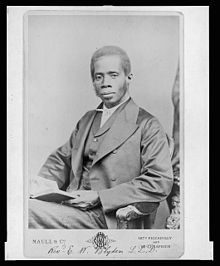
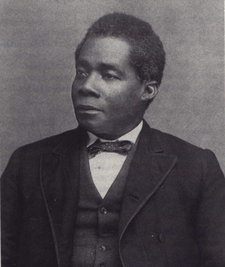
Edward Wilmot Blyden: Father of Pan-African ThoughtEdward Wilmot Blyden was born 3 August 1832 in the Danish West Indies (Currently known as the United States Virgin Islands) on the island of St. Thomas. In 1845 Blyden met Reverend John P. Knox. He was the pastor of the St. Thomas Protestant Dutch Reformed Church. Knox soon became impressed with the young Blyden's studious nature. Mostly due to his close proximity to Knox, Blyden became a minister, much to the pleasure of his parents.
In May of 1850, Blyden went to the United States with Knox's wife, and tried in vain to enroll in Rutgers Theological College, as well as two others. Knox encouraged Blyden to move to Liberia where his efforts could reap fruition. Later that year Blyden arrived in Liberia and became deeply involved in the new country's development. From 1855 to 1856, Blydenwrote a column for and edited the Liberia Herald. He also spent time writing and editing for other budding newspapers in Nigeria and Sierra Leone. In 1861, Blyden became professor of Greek and Latin at Liberia College, and from 1880 to 1884 he was president of the college. Blyden also served as ambassador for Liberia to Britain and France. From 1864 to 1864, Blyden was appointed as the Liberian Secretary of State, and Minister of the Interior from 1880 to 1882. Blyden traveled to the United States and spoke to many major black congregations of the time. Blyden advocated to African Americans that the suffering due to racial discrimination could be ended by repatriating back to Africa and developing the mother land. Because of ideas like this, Blyden is regarded widely as the "father of Pan-Africanism". His most notable book is Christianity, Islam, and the Negro Race (1887). Where he argues that Islam is a more fulfilling and unifying practice for those of African descent. Edward Wilmot Blyden Died on 7 February 1912 at the age of 79. information gathered from http://en.wikipedia.org/wiki/Edward_Wilmot_Blyden
0 Comments
Leave a Reply. |
BlogCategories
All
|